
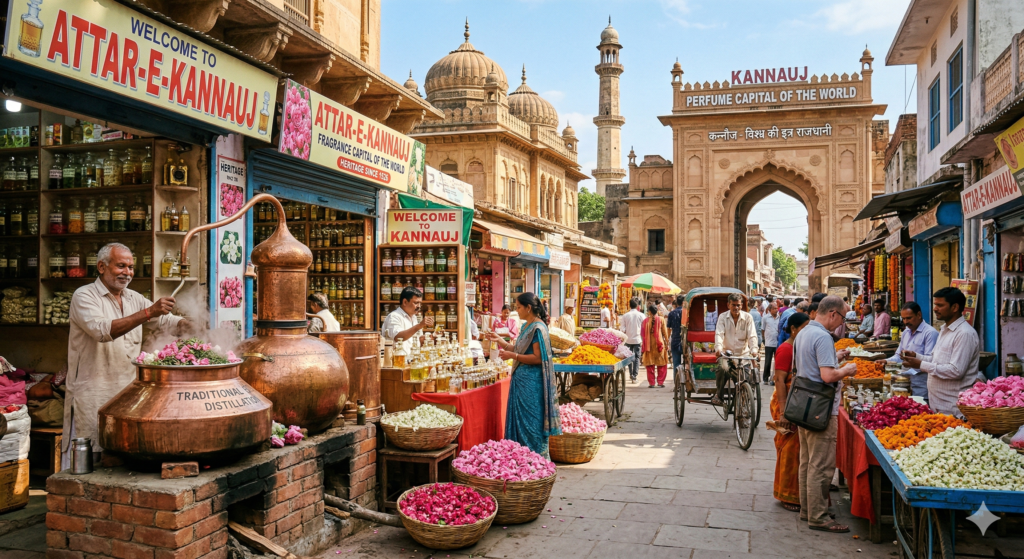
Kannauj: A Journey through Time
Kannauj, often hailed as the “Grasse of India” and the “Perfume Capital of India,” stands as a testament to the ancient art of perfumery, steeped in centuries of history and tradition. This city, nestled in the heart of Uttar Pradesh, has been crafting exquisite fragrances for millennia, weaving a fragrant tapestry that continues to captivate the senses and solidify its place as the undeniable “Fragrance Capital of the World.”
The history of Kannauj is intricately intertwined with the rise and fall of great empires and the enduring craft of creating delicate scents. Its roots trace back to ancient times, with mentions in historic texts and scriptures as a center of culture and trade. However, its true emergence as a prominent hub of perfumery coincided with the Mughal era, particularly during the reign of Emperor Jahangir. Legend has it that Jahangir’s wife, Empress Nur Jahan, played a significant role in introducing and promoting the art of manufacturing fine fragrances from natural sources like rose petals and vetiver. This imperial patronage provided the much-needed impetus to the local perfume industry, and Kannauj soon flourished as the epicenter of aromatic creations.
Why Kannauj is the Fragrance Capital of the World
1.Centuries-Old Tradition: For generations, families in Kannauj have dedicated their lives to the intricate process of creating perfumes, passing down knowledge and expertise through the ages. This deep-rooted tradition has ensured the preservation and refinement of ancient techniques that contribute to the uniqueness and quality of Kannauj’s fragrances.
2. Natural Resources: The region around Kannauj is blessed with fertile land and a favorable climate that supports the growth of a diverse array of flowers, herbs, and other aromatic plants. Roses, jasmine, marigolds, and vetiver, all crucial for perfume production, flourish in abundance, providing the raw materials that fuel the city’s fragrance industry.
3.Traditional Distillation Methods: The true essence of Kannauj’s perfumes lies in its reliance on traditional distillation methods, particularly the use of the “deg and bhapka” system. This manual, hydro-distillation process, which uses copper vessels, allows for the gradual extraction of essential oils from flowers and herbs, preserving their delicate aroma and producing natural, chemical-free fragrances.
4. The “Ittar” Legacy: Kannauj is particularly famous for its “ittars,” natural perfumes derived primarily from plant materials like flowers, wood, or herbs. Unlike alcohol-based perfumes, ittars are long-lasting and retain their genuine, unaltered scent, making them highly sought after by fragrance connoisseurs worldwide.
5. Geographical Indication (GI) Tag: In recognition of its historical significance and unique perfume-making practices, Kannauj was awarded the GI tag in 2013 for its traditional method of perfume production. This prestigious accolade further validates Kannauj’s claim as the fragrance capital of India and solidifies its reputation globally.
AI Overview
The fragrance industry in Kannauj faces various challenges in the contemporary landscape. The rise of synthetic perfumes, coupled with the decline in the cultivation of traditional flowers due to changing environmental conditions and market demands, poses a threat to the city’s perfume-making heritage. Additionally, a lack of modern infrastructure and branding has made it difficult for Kannauj’s traditional perfume makers to compete in the global market. However, the use of technology like AI can provide innovative solutions to these problems, from improving the efficiency of perfume extraction to optimizing supply chain management and marketing strategies.
FAQs
- What is the most famous perfume of Kannauj? While Kannauj produces a range of exquisite fragrances, its rose-based “ittars,” such as “Ruh Gulab” and “Gulaab ka Ittar,” are globally renowned for their purity and rich aroma.
- Are Kannauj perfumes natural? Yes, traditional Kannauj perfumes, or ittars, are derived entirely from natural plant materials like flowers, herbs, and wood, and are produced using traditional hydro-distillation methods without any chemicals.
- How is Kannauj perfume made? Traditional Kannauj perfumes are made using the “deg and bhapka” distillation system. Flowers or herbs are cooked with water in large copper degs (pots), and the vapor, containing the essential oils, is condensed and collected to produce pure ittar.
- Is Kannauj safe for tourists? Yes, Kannauj is a relatively safe city for tourists. It offers a unique cultural experience, allowing visitors to witness the traditional perfume-making process firsthand and explore historical sites like the Archaeological Museum.
- Where can I buy authentic Kannauj perfumes? Authentic Kannauj perfumes can be purchased directly from traditional perfume makers and local markets in Kannauj. However, with the rise of online platforms, many reputed brands from Kannauj now sell their products online, reaching customers globally.
Conclusion
Kannauj, with its millennia-old history, traditional perfume-making techniques, and natural resources, stands as a symbol of India’s rich cultural heritage. While it faces modern challenges, its dedication to preserving its unique fragrance legacy, combined with the potential for technological innovation and increased global recognition, ensures that Kannauj will continue to enchant the world with its delicate, natural scents for centuries to come.